What to Do With an Awkward Angled Wall

If you’re standing in a room wondering what to do with an awkwardly angled wall, I promise you’re not alone. It’s one of the challenges I run into constantly as an interior designer, and honestly, it’s one of my favorites to solve.
Angled walls, sloped ceilings, and odd corners show up in older homes, attic spaces, and even brand new construction. They make for some super awkward spaces and can make an otherwise nice room feel harder to furnish than it has any right to be, even with the right decorative elements.
The good news is that awkward angles are almost always fixable without touching the structure at all; they are just one of those unique challenges that make for a unique space. I’ve tackled this exact problem on my show, Problem Spaces, more than once, and the same handful of tricks keep working every time, and it almost always comes back to creating more visual interest in the living space.
What to do with Awkward Angled Walls
Don’t Paint the Angled Wall a Different Color
I get why the instinct is there. If a wall is doing something weird, paint it a different color to call it out and get it over with, right? Wrong, unfortunately.
I learned this the hard way while filming an episode of Problem Spaces called “Extreme Angles.” The homeowner, Kim MacRae, had already tried painting her primary bedroom’s main angled wall a different color to soften it, but it wasn’t quite the right approach. As I told her on camera, a contrasting wall color only makes the angle more obvious, since it draws your eye straight to the exact spot where the lines break. It is a great way to make the eye sore even more of an eye sore.

What actually works is going monochromatic. Paint the walls, trim, and even the ceiling one single color, and you remove the visual break where the angle changes direction entirely. It’s a well known trick for disguising imperfect architecture in older homes with less than perfect lines, and it works just as well here.
A lighter color tends to feel more expansive in a small space, while a deeper, moodier shade can make an oddly angled room feel intentionally cozy instead of just odd. Either direction is a good idea. Just commit to it fully instead of mixing colors across the angled sections.
Vertical Paneling Is Basically Cheating (In a Good Way)
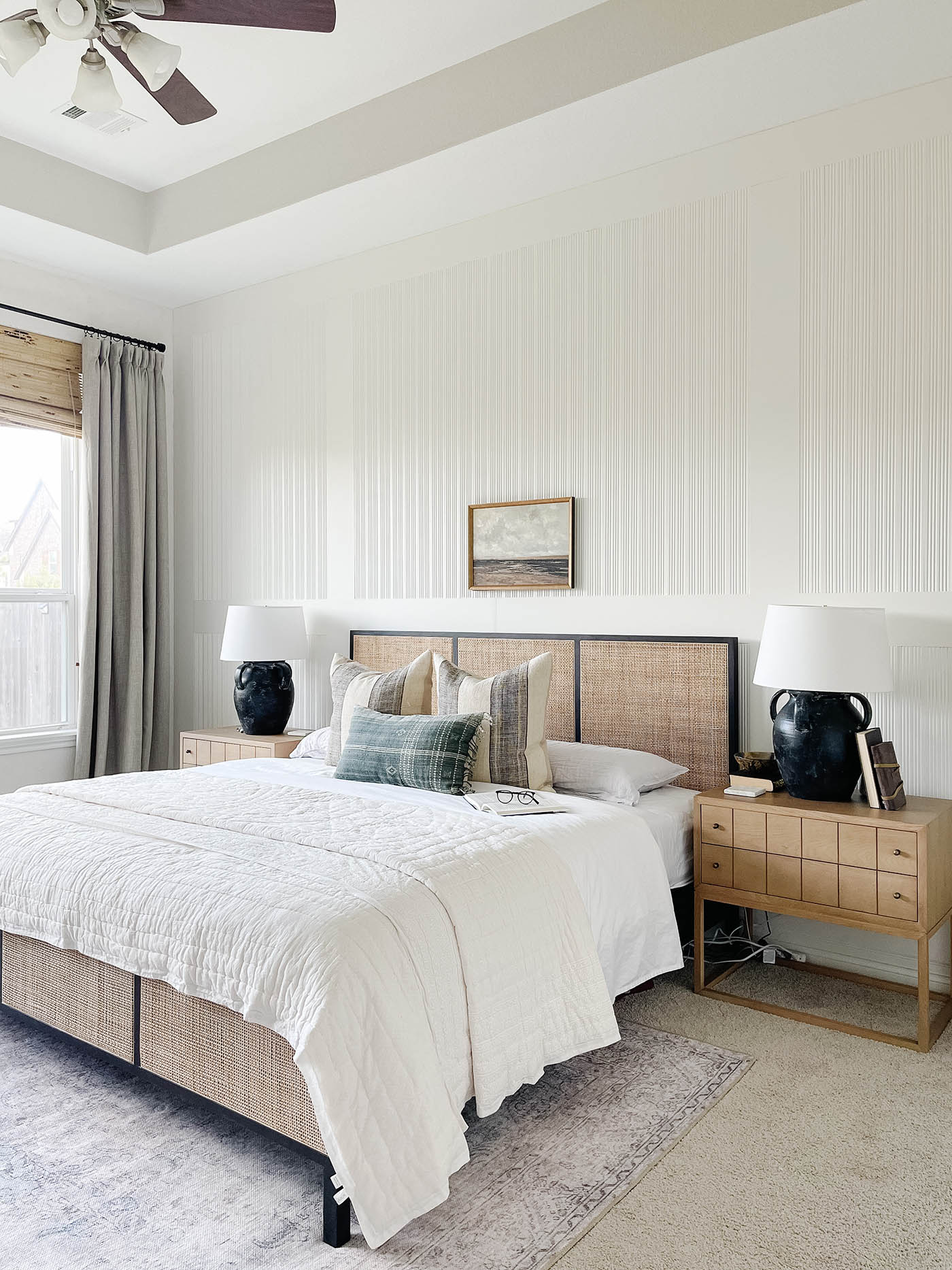
Once we ruled out paint alone, we needed a bigger move for that MacRae bedroom, so I installed floor to ceiling vertical shiplap on the problem wall.

Vertical lines pull your eye straight up. That’s really the whole trick. It creates the illusion of a straighter wall and adds a streamlined architectural feature at the same time, so you’re not just hiding the angle, you’re giving people something better to look at instead. It’s one of my go-to moves for a slanted wall, a sloped ceiling, or a dormer window eating into your floor space, because that upward movement counteracts the diagonal line the angle creates. Done right, it reads as a deliberate design choice, not an apology for the architecture. It’s also one of the more affordable architectural features you can add, since you’re only covering the one problem wall, not the whole room.
Wallpaper the Whole Room in the Same Print

This one feels almost too simple, but wallpapering an angled wall in the exact same paper as the rest of the room does a genuinely great job of blurring where the angle starts and stops, and that is exactly what I did in my playroom makeover.
Because the pattern keeps going uninterrupted across the flat walls and the angled ones, your brain reads the whole space as one continuous wrap instead of clocking the specific spot where the ceiling starts to slope. This works especially well in a small nook, an attic bedroom, or any room fighting more than one awkward angle at once. And counterintuitively, a bolder wallpaper actually works better here than something quiet, since a busier pattern gives your eye more to focus on than the architecture underneath it.
Awkward Nooks Need Custom Furniture, Not Store-Bought
Here’s the thing about a truly odd nook or corner: standard furniture is never going to fit it right, and trying to force it just makes the space feel more awkward.

In Episode 4 of Problem Spaces, “A Tale of Two Nooks,” I ran into a jutted-out structure attached to a client’s main living area that no store-bought piece could solve. So I designed floor to ceiling built-in shelving on one side, a lower bench that doubled as seating and storage on the other, and a raised ledge to tie the whole thing together. The goal was for the space to blend so seamlessly into the living area that guests wouldn’t even register it as a problem spot.

That same episode also had a round turret room with gorgeous high ceilings that still felt overcrowded, which tells you unique spaces don’t even have to be angular to feel this way. Custom furniture, built for the actual footprint of the room, almost always beats anything off the shelf when standard pieces just leave dead space behind.
Where Do You Even Put the Furniture?
Once the wall itself is handled, the next question is always furniture placement, and honestly, this trips people up more than the angle does.

My rule of thumb: anchor your bigger pieces, a sofa, a media console, along the longest flat stretch of wall you’ve got, then let the angled portion hold something lower profile, like a reading chair or a slim console table. You’re working with the room’s natural flow instead of forcing a symmetrical layout onto a wall that was never going to give you one. In a more open floor plan, an angled wall can actually work in your favor by defining separate zones within one bigger space, which is a great excuse to add a rug that visually anchors each area.
What if You’re Dealing With a Half Wall or a Narrow Room?
Half walls paired with an angle can feel like double the visual noise if you’re not careful. I try to keep decorative items to a minimum right at that transition point and let the architecture do the talking instead.
In a narrow living room, oversized furniture only makes an angle feel more cramped, so scaling down and choosing pieces that don’t compete with the opposite wall keeps everything feeling balanced instead of chopped up into pieces.
Turn the Angled Ceiling Into the Best Part of the Room
I genuinely believe an angled ceiling can become the most memorable part of a room instead of the thing you’re trying to hide.

In Episode 6, “Upscale DIY,” I turned an awkward bedroom nook with an angled ceiling into a real focal point using custom wall designs, a chair rail in a mid-tone stain, and a bold two-toned color scheme that looked stunning against the natural light in the room. I also hung artwork between the box molding for a personal, gallery wall feel without fighting the architecture, and added privacy screen doors that let light filter through without making the space feel closed in.
The lesson from that project holds up everywhere. An angled ceiling doesn’t need to disappear. Layer in the right lighting, whether that’s a wall sconce, picture lights, or a well placed pendant, and it can genuinely become the best part of the space.
Lighting Changes Everything About How an Angled Room Feels


I’d argue good lighting plays a bigger role in whether an angled room feels awkward or intentional than the angle itself does.
One overhead fixture almost never reaches every corner of a room with a sloped ceiling or a jutting angle, so I always layer in a few different sources instead of relying on one. A wall sconce on the flattest part of the wall, a floor lamp tucked into the tighter section of the angle, picture lights aimed at a favorite piece of art, each one does more heavy lifting than a single bright overhead fixture ever could. Good lighting doesn’t just make the room easier to actually use. It adds real drama to whatever feature you’ve chosen to highlight, whether that’s the paneling, the wallpaper, or a built-in.
The Small Stuff Matters Too

A few low-effort touches go a long way toward making an angled wall feel like a choice you made on purpose, not something you’re stuck with.
Area rugs, an accent chair, or a console table placed to work with the angle instead of against it add real visual balance. A decorative mirror on the flattest available section reflects light and gives you a display area without competing with the slope. Soft textiles like curtains or a throw take the hard edge off the architectural lines, and a floor lamp tucked into the tightest part of the angle often solves a lighting gap better than any fixed overhead fixture could. Little touches like these are what actually give a room your personal style, even when the bones of the space are working against you.
Frequently Asked Questions

What is the best paint color for an angled wall?
A single, consistent color used on the walls, trim, and ceiling works best. It removes the visual break where the angle changes direction, rather than drawing attention to it with contrast.
Should I match wallpaper on an angled wall to the rest of the room?
Yes. Using the same wallpaper throughout blurs the transition point and makes the whole room read as one cohesive space instead of highlighting where the angle begins.
What furniture works best in a room with angled walls?
Custom or built-in furniture designed around the specific footprint of the room almost always outperforms standard furniture, especially in nooks, turrets, or sloped ceiling spaces.
Can an angled wall actually become a good design feature?
Yes. Vertical paneling, a bold accent treatment, or artwork placed intentionally can turn an awkward angle into one of the most memorable parts of a room.
Does lighting really make that much of a difference in an angled room?
Yes. Layered lighting, rather than one central fixture, evens out the dark corners an angle tends to create and helps the whole room feel more intentional.
An awkward angled wall doesn’t have to be the thing you design around forever. Between a monochromatic paint approach, vertical paneling, matching wallpaper, thoughtful furniture placement, and a few custom built-ins, there’s almost always a way to turn the problem into a standout feature instead of something you keep apologizing for.
If you’ve got a space like this in your own home, start with paint and lighting before you invest in anything custom. Sometimes the smallest change ends up making the biggest difference in how the whole room feels.
This post contains affiliate links to products that I used or recommend. If you purchase something through an affiliate link, I may receive a small percentage of the sale at no extra cost to you. I really appreciate your support!